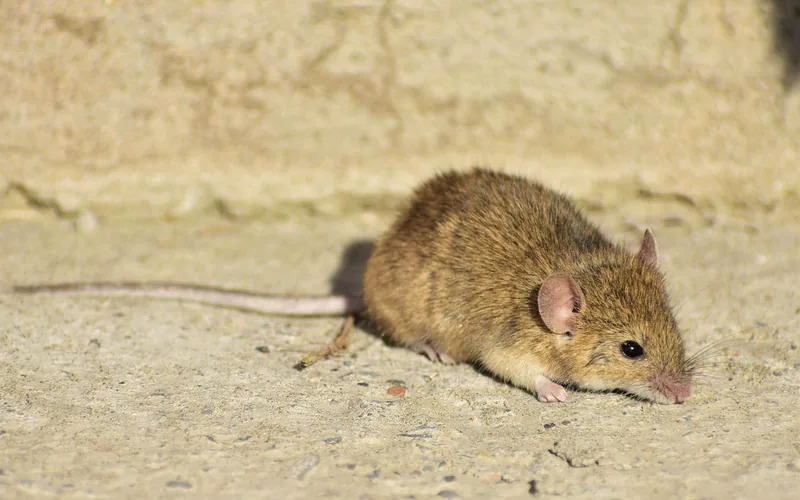
A house mouse weighs about as much as two small batteries. Its skull is the widest part of its body, so the rule is simple: if the skull goes through, the mouse goes through.
The pencil test
Take a pencil. Its diameter is about seven millimetres. An adult house mouse can pass through a gap of six.
That single number explains most mouse problems. A building does not need a hole in the wall. It needs a gap under a door, a slot around a pipe, a missing brick vent, a corner where two panels do not quite meet.
Why the body allows it
A mouse is not liquid, but it is close to it in practical terms. The skull is narrow, the ribcage is flexible, and the fur slides over surfaces.
The animal does not need to force anything. It walks through a gap that its whiskers tell it will fit.
Where the gaps actually are
Under an outside door, especially where a threshold has worn.
Around pipes and cables where they enter a wall or a cabinet.
A tumble dryer vent, a boiler flue collar, an air brick with a broken grille.
The corner where a garage door meets its frame.
Where siding or cladding meets the foundation, and along a roof line.
None of these look like an entrance. All of them are.
They travel by touch
Mice have poor eyesight and excellent whiskers. They move with one side of the body against a surface, which is why the route is almost always a line along a wall rather than a straight run across a floor.
Over weeks that contact leaves a faint dark smear along the edge, and a line of droppings in the same place. The smear is the map.
Why one mouse is rarely one mouse
A house mouse can produce five to ten litters a year, with five or six young in each. Young animals disperse, which is why a sighting often follows a quiet period rather than a sudden invasion.
Their home range is small, often under ten metres. If you are seeing one regularly, the nest is close.
Closing the gap, in practice
The order that works is boring and effective. Find the routes with a torch at dusk, then close them with something a mouse cannot chew: wire wool packed into the gap and sealed over, metal plate, a brush strip on the bottom of a door.
Catching comes second. Traps set along the wall, with the trigger against the skirting board, catch the animals that are already inside.
One caution worth repeating. Rodent bait placed where pets or children can reach it is a real risk, and a mouse that dies inside a wall void is a smell you cannot get to.
Photo: Amirekul, CC BY-SA 4.0, via Wikimedia Commons.