A German cockroach population can double every few weeks. What you do in the first fortnight decides whether you end it or just push it into the next room.
Why German roaches are a different problem
A German cockroach female carries her egg case until the nymphs are almost ready to hatch, and she can produce four to eight of them in a lifetime. Each case holds thirty to forty nymphs.
In a kitchen that is warm, humid, and never more than a metre from food, a nymph reaches adulthood in about six weeks.
That arithmetic is why a single sighting in March can be an infestation by June, and why the first two weeks of treatment decide the outcome more than any choice of treatment does.
They are also the one common species that rarely comes in from outside. American and oriental roaches move in from drains, basements, and the yard.
German roaches live in the cabinet, behind the dishwasher, inside the motor housing of the refrigerator. Treating the room does not treat the problem if the problem is behind a panel.
Identify before you treat
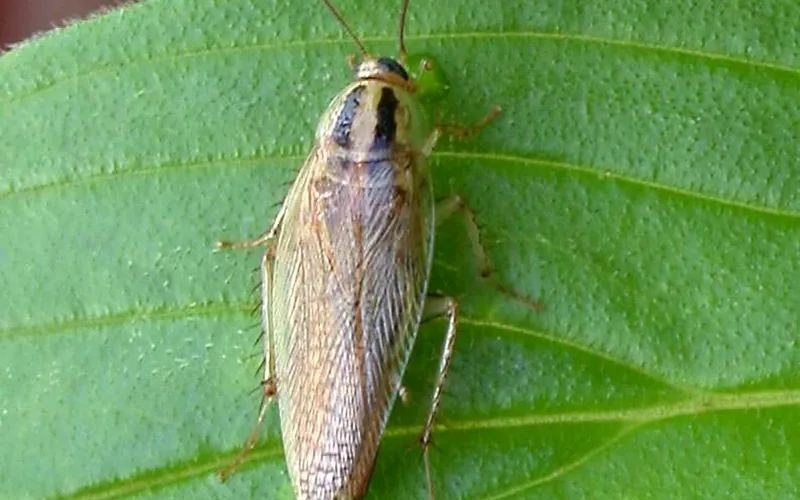
German roach: 13 to 16 mm, tan to light brown, two dark parallel stripes behind the head.
Oriental roach: uniformly dark brown, larger, found in basements and floor drains.
American roach: flies, and 35 mm or more.
Nymphs: smaller and darker, with a single pale stripe down the back.
German roaches are 13 to 16 mm, tan to light brown, with two dark parallel stripes running from the head across the shield behind it. Nymphs are smaller, darker, and carry a single pale stripe down the back.
If the insect is uniformly dark brown, larger, and you found it in a basement or a floor drain, it is probably an oriental roach. If it flies, and it is 35 mm or more, it is American.
The distinction matters because oriental and American roaches usually originate outside the building, and no amount of indoor baiting will hold if the entry point stays open.
Why spray loses to bait
A pyrethroid spray kills what it touches, and it also repels. Roaches that survive contact move deeper into the wall void or into the next unit, so the population redistributes rather than shrinks.
In a detached house that looks like failure. In an apartment building it looks like your neighbours suddenly have roaches, and it is the single most common way a small problem becomes a building-wide one.
Gel bait works by the opposite mechanism. A roach eats a dose of fipronil or dinotefuran, returns to the harbourage, and dies there.
Because roaches feed on dead nestmates and on faeces, part of that dose is recycled through the population. You are not killing the insects you can see. You are dosing the colony.
Placement is where most treatments fail
Dabs the size of a grain of rice, every 15 to 20 cm.
The hinge side of cabinet doors.
The corner where the counter meets the wall.
Around pipe penetrations under the sink.
The top edge of drawer slides.
Behind the refrigerator and the dishwasher.
Inside the void where the cabinet meets the wall.
Dabs the size of a grain of rice, every 15 to 20 cm, in the places roaches actually travel: the hinge side of cabinet doors, the corner where the counter meets the wall, under the sink around the pipe penetrations, along the top edge of drawer slides, behind the refrigerator and the dishwasher, and inside the void where the cabinet meets the wall.
Three rules matter more than which method you pick. Do not spray a surface you have just baited, because the repellent keeps them off the bait.
Do not wipe the bait away when it looks unsightly, because it stays active for months. And do not bait only the kitchen, because a bathroom ten metres away is the same population.
The timeline you should expect
Days one to three: activity often increases. Roaches are competing for the bait and the colony is disturbed.
This is the point where most people conclude the treatment failed and reach for a spray, which is the most reliable way to lose the treatment.
Days four to fourteen: the visible population collapses as the dosed insects die in the harbourage. Weeks two to six: egg cases laid before treatment hatch, and a second, smaller wave appears.
A second application at week three covers it. Judging a baiting programme on day four is judging it before it has started.
After the population is down
Bait does not fix the conditions that produced the roaches.
Grease on the range hood, dry goods in cardboard, a drip under the sink, the bin left overnight: each of these keeps the carrying capacity of the kitchen high. Do not carry cardboard boxes into the house. Egg cases are laid in the corrugation and survive the trip.
Caulk the gaps around pipe penetrations and the seam where the counter meets the wall. A German roach needs a gap about the width of a coin, and those same gaps are how the neighbours roaches get through.
When to stop and call someone
If you live in a multi-unit building and the infestation returns within a month of a full treatment, the source is probably not in your unit. Baiting one apartment in a connected block is a temporary fix.
The same applies if you have treated three times and still see nymphs: a breeding population is being missed, and finding it needs a flashlight and a long look behind the appliances, not another round of treatment.
Photo: Lenny Worthington, CC BY-SA 2.0, via Wikimedia Commons.