Almost every cockroach indoors is one of three species. They are easy to tell apart once you know what to look at, and they do not behave the same way.
Why the species matters
People usually say roach and stop there. But the three common indoor species live in different places, breed at different speeds, and arrive for different reasons.
Getting the species right turns a vague worry into a specific job. Here is the short version.
The small one with two dark stripes
The German cockroach is the one that lives with us. Adults are around 13 mm long, light brown, with two dark parallel bands on the shield behind the head.
It almost never flies. It spends its life in the warm, wet parts of a building: behind a fridge, under a sink, inside a cabinet hinge, along the seam where a worktop meets a wall.
It is also the fastest breeder of the three. One female carries four to eight egg cases, each holding thirty to forty young, and a warm kitchen shortens the time between generations.
The big one that comes up the drain
The American cockroach is the large reddish brown one, up to 40 mm, with a pale rim around the shield behind the head. It can fly in warm weather.
It usually lives outside the living space: in sewers, drains, boiler rooms, rubbish areas and damp basements. Indoors it is a visitor that came up a pipe or under a door.
That is why seeing a big one in a bathroom at night does not mean the flat is infested. It means there is a route in.
The dark one that likes damp
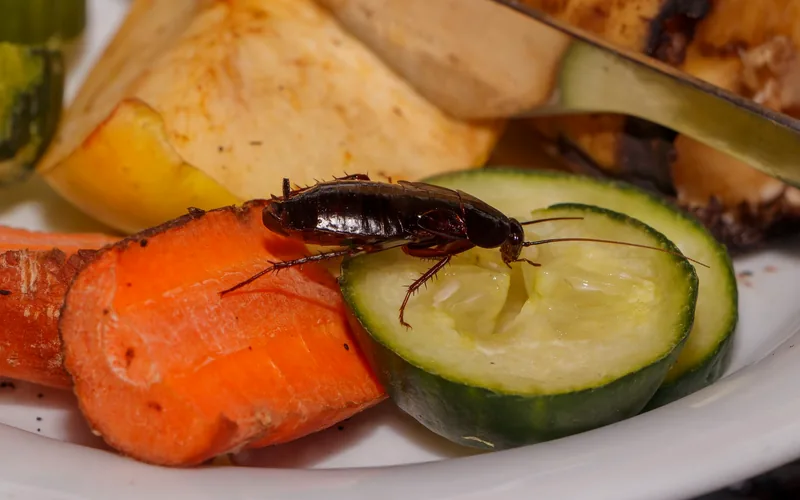
The Oriental cockroach is dark brown to black, around 25 mm, with wings too short to cover the abdomen. It cannot fly and it does not climb smooth surfaces well.
It prefers cool, wet places: cellars, drains, gaps under paving, leaf litter against a wall. Of the three it is the one most likely to survive a cold winter outdoors and walk in when the weather turns.
What to look at, in order
Size: small, medium or large.
The shield behind the head: two stripes, a pale rim, or plain dark.
The wings: covering the body, or too short to.
The place you found it: a warm kitchen, a drain, or a damp cellar.
Those four answers are usually enough. A photo taken from above, in good light, settles it.
What each answer means
German cockroaches breed indoors, so the hiding places have to be dealt with, not just the ones you see. A bait placed into the cracks where they already walk does more than a surface spray, because the insects have to meet it.
American and Oriental cockroaches are usually coming in from outside. Finding and closing the route, a drain cover, a gap under a door, a pipe collar, matters more than the number you kill indoors.
One more thing worth knowing: cockroaches groom constantly and shelter in groups, which is why an infestation builds quietly for months and then seems to appear all at once.
Photo: H. Zell, CC BY-SA 3.0, via Wikimedia Commons.