Spraying a trail feels like progress. For many species it splits the colony instead: one nest becomes four, and the problem gets bigger.
Which ants actually matter
Most of the ants that walk through a kitchen are a nuisance that contaminates food. Two groups are more than that.
Fire ants sting repeatedly, and a small proportion of people react severely enough to need medical attention.
Carpenter ants excavate wood, they do not eat it, and a long-standing nest can hollow out a sill or a stud.
Pharaoh ants are the third problem case. They carry pathogens through food-handling areas, and they are the species most likely to be made worse by spraying.
Identify the species, because the bait depends on it
Odorous house ant: 1.5 to 3 mm, dark brown with a single node on the waist.
Argentine ant: 2 to 3 mm, uniform light to dark brown, several workers per trail.
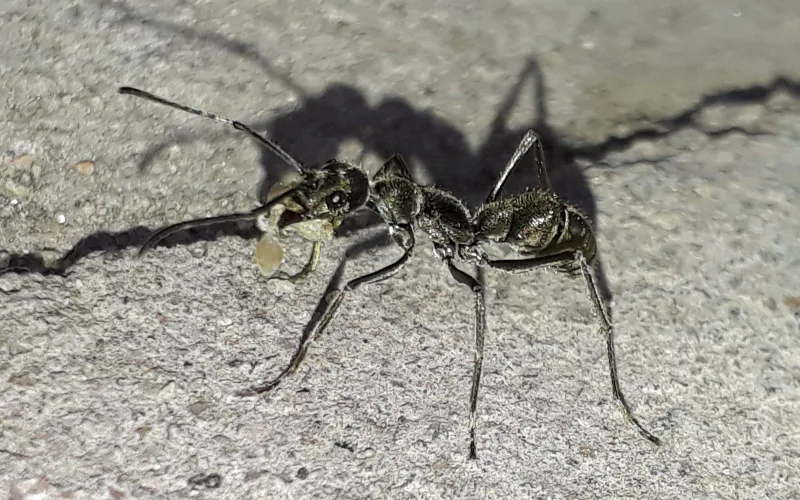
Carpenter ant: 6 to 18 mm, large, black or reddish, and nests in wood rather than soil.
Fire ant: 4 to 6 mm, reddish with a darker head, and it stings.
Watch what the trail is carrying. Ants heading for grease, oil, and protein are usually a different species from those heading for sugar, honey, and fruit juice.
A bait that does not match the preference will sit untouched while the colony carries on feeding somewhere else.
Carpenter ants are large, black or bicoloured, and active at night. Finding one indoors in winter usually means a nest in the structure, not an invasion from outside.
Pharaoh ants are tiny, pale yellow, and they run in a single tight line. Fire ants build mounds in open ground and respond to disturbance by swarming.
Find the nest, not the ants
Follow the trail out from the food source, not back to it.
Look for a trail that widens as it goes, because more workers use it.
Check under the sink, behind the fridge, in the pantry and along the skirting.
Outside, look for a mound, a crack in the foundation, or a nest under a pot.
Follow the trail backwards at dusk, when traffic peaks. Look along skirting boards, behind appliances, under paving slabs, in the gap between a wall and a cabinet, and around utility penetrations.
Outdoor nests are often visible as a small mound of excavated soil or a line of debris along a paving joint.
If the trail disappears into a wall void, mark the point and treat the void rather than the room. Killing the foragers is a temporary reduction. The colony replaces them within days.
Why spraying a trail backfires
A repellent spray kills the workers it hits and contaminates the pheromone path. The colony responds by doing what ants do under stress: it splits.
One nest becomes two or three satellite nests, each with its own queen, and the problem is now larger and harder to locate than it was before you started.
In Pharaoh ants this is a well-documented outcome, and it is why the standard advice for that species is never to spray at all.
The same mechanism explains why household ant spray so often produces a week of relief followed by a worse problem.
What bait does instead
A bait is a dose of slow-acting insecticide in a food matrix the colony will carry. Workers take it back, share it through trophallaxis, and feed it to the larvae and the queen. The delay is the point. A fast-acting poison kills the forager in the kitchen and never reaches the nest.
Place stations along the trail and leave them alone. Do not wipe the trail clean, because the pheromone path is how the workers find the bait.
Do not add bait next to a station that is already being worked, because you will split the traffic. Expect visible activity to rise for two or three days before it collapses.
That is the same pattern as cockroach baiting, and it reads as failure to anyone who has not seen it before.
Keep stations out of reach of children and pets, and use a tamper-resistant design outdoors.
Close the routes
Trim vegetation back from the foundation by at least 30 cm. Seal cracks in the slab and around utility penetrations. Move firewood and stored materials away from the wall.
Keep pet food off the floor overnight, and fix the dripping outdoor tap, because ants need water as much as food.
For nests in open ground, a labelled granular bait or a direct mound treatment works. For nests inside a wall, drill-and-treat or baiting is the option, and that is usually a professional job.
When to stop treating and start diagnosing
If ants return to the same spot within two weeks of a baiting programme, the nest you treated was not the nest feeding that trail. Re-trace at dusk, starting from the other end.
Repeated treatment without locating the colony is how a small seasonal problem becomes a permanent one.
Photo: Memainak, CC BY-SA 4.0, via Wikimedia Commons.