A herbicide applied at the wrong soil temperature is money spent for nothing. Timing beats concentration almost every time.
Why a thin lawn becomes a weed problem
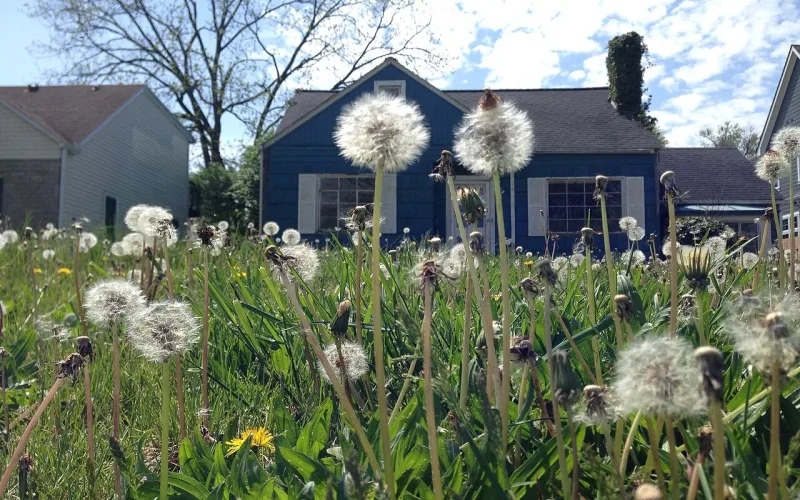
Weeds do not invade a dense lawn. They colonise the gaps in a thin one.
Crabgrass germinates in bare soil warmed by sun, dandelion establishes where the canopy is broken, and each of them then spreads seed across the whole property.
A few plants in spring are a lawn-wide problem by autumn, and the reason is competition for the same water, light, and nitrogen the grass needs.
Three categories, three approaches
Broadleaf weeds in an established lawn: a selective broadleaf herbicide.
Grasses and sedges: a separate category, and most broadleaf herbicides will not touch them.
Bare ground and cracks: a non-selective herbicide, used carefully and away from the lawn.
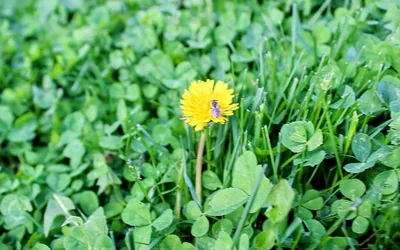
Broadleaf weeds, which is dandelion, clover, plantain, and thistle, respond to selective herbicides containing 2,4-D, dicamba, or a related active.
Selective means it affects the broadleaf and not the established grass, provided the rate and the temperature are within the label.
Grassy weeds, which is crabgrass, foxtail, and goosegrass, are in the same family as the lawn, so a selective broadleaf herbicide does nothing at all.
They need a pre-emergent applied before the seed germinates, or a post-emergent labelled for that species.
This is the most common mismatch: a broadleaf herbicide bought for a crabgrass problem.
Non-selective herbicides, glyphosate being the obvious one, kill everything they touch. They belong on hard surfaces, along fence lines, and in full renovations. Not on a lawn you intend to keep.
Timing is the variable that decides the result
Pre-emergent has to be down before soil temperature reaches about 55 degrees Fahrenheit at two inches of depth. In practice the signal is forsythia in bloom.
Applied after germination it does nothing, which is why the same herbicide works for one homeowner and fails for the neighbour.
Post-emergent works best on young, actively growing weeds. Many herbicides lose selectivity or damage turf above roughly 85 degrees Fahrenheit, so a July afternoon application is the wrong choice twice over.
Apply in the evening or on an overcast day, and do not mow for two or three days either side, because the leaf area is how the herbicide gets in.
Rain within a few hours of application can wash a post-emergent off before it is absorbed. Check the forecast, not the calendar.
Application details that decide whether it works
Mow at a different height for a week before and after, so the plant is actively growing.
Do not mow for three days after applying, so the herbicide stays on the leaf.
Water lightly the next morning if it does not rain.
Check the label for the interval between applications before repeating.
Spray to wet, not to runoff. A dripping leaf is herbicide going into the soil, not into the plant. Use a flat-fan nozzle at low pressure, keep the boom height consistent, and do not spray on a windy day. Drift onto a neighbour tomatoes is both a failure and a liability.
Clean the tank thoroughly between herbicides. A trace of glyphosate left in a tank used afterwards for lawn herbicide will show up as dead streaks, and no amount of rinsing after the fact will fix the lawn.
Calibrate the sprayer before you start. A small error in walking speed changes the delivered rate by more than most people expect, and the label rate is not a suggestion.
Measure a strip, time the pass, and check the volume used. It takes ten minutes, and it is the difference between a treatment and a wasted afternoon.
Build a lawn that resists weeds
Mow high, around three inches, so the canopy shades out seedlings. Water deeply and infrequently to encourage deep roots rather than shallow ones.
Overseed bare patches in early autumn, when the soil is still warm and the air has cooled. Fertilise to the label rate, because extra nitrogen favours weeds as often as it favours grass.
Test the soil every few years. A pH outside the 6.0 to 7.0 range locks up nutrients and produces a lawn that cannot compete, no matter how much herbicide you apply.
When the problem is not the weed
If the same patch of crabgrass returns every year in the same place, the issue is compaction or drainage, not the herbicide.
Core-aerate in early autumn, top-dress with compost, and fix the grade so water does not pool. Killing the weed without fixing the site guarantees it comes back.