Poison on its own almost never ends a mouse problem. The animals that die indoors are the ones you notice; the ones that keep breeding are the ones you do not.
What a mouse actually costs you
The damage that matters is rarely the food. Mice gnaw constantly to keep their incisors worn, and the material they prefer is often the insulation on electrical cable. Rodent-chewed wiring is a well-documented ignition source in house fires.
Add urine and droppings on food-contact surfaces, fleas and ticks carried indoors, and the two pathogens public health agencies name most often, hantavirus from droppings and saliva and salmonella from contamination, and the case for acting early is straightforward.
Three species, three behaviours
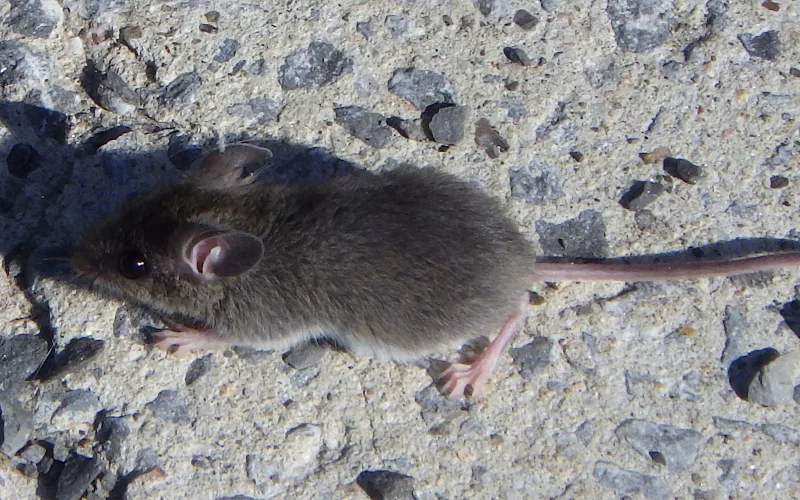
The house mouse is small, curious, and rarely travels more than ten metres from its nest. It feeds in short bursts and caches food, which is why you find a pile of dog kibble behind a drawer.
The roof rat is a climber: it lives in the loft, in the void above the ceiling, and along the tops of walls, and it is wary of anything new in its path.
The Norway rat lives at ground level, in burrows along foundations and under sheds, and it needs standing water.
The distinction changes the plan. Bait stations on the floor will not reach a roof rat living in the attic. Traps set along a skirting board will not intercept a Norway rat whose burrow is outside the wall.
Read the building before you treat anything
Droppings along skirting boards and inside drawers.
Dark greasy smear marks where fur brushes a surface repeatedly.
Gnaw marks on packaging or pipe insulation.
Scratching in the loft or wall cavity after dark.
Droppings along skirting boards and inside drawers, dark greasy smear marks where fur brushes a surface repeatedly, gnaw marks on packaging or pipe insulation, and scratching in the loft or wall cavity after dark.
A mouse needs a gap of roughly 6 mm, the width of a pencil, to get in. A young rat needs about 20 mm.
Walk the outside of the building with a flashlight. Check where pipes and cables enter, the gap under the doors, the vents, the roof line, and the corner where the siding meets the foundation.
That walk usually finds the answer, and the answer is usually a gap you can close in an afternoon.
The order that works: exclude, then control
Exclusion first, because control without exclusion is a subscription. Pack the gaps with wire wool and seal over it. Rodents cannot chew through steel wool, but they will chew through foam and plastic mesh.
Fit brush strips or kick plates to the bottom of doors. Screen the vents. Repair torn soffit. Trim branches that touch the roof, because roof rats use them as a bridge.
Then control. Snap traps are the fastest way to confirm what you have and to remove it: they kill quickly, they show you the result, and there is no secondary poisoning risk to a pet or to a hawk.
Set them along walls, perpendicular to the wall, with the trigger against the skirting board, because mice travel within a whiskers width of vertical surfaces. Peanut butter or a sliver of nut works better than cheese.
Bait belongs in a tamper-resistant station, never loose, and never in a house with pets or children unless the station is locked and anchored. Rodenticides are anticoagulants. A dog that eats a dead mouse has not eaten a dose, but a dog that eats the bait has.
Why poison alone rarely ends it
Three reasons. Rodents with a reliable food source, the bird feeder, the compost heap, the pet bowl left out overnight, often ignore bait entirely.
A rat that dies inside a wall cavity creates a smell problem you cannot reach without opening the wall.
And repeated use of the same active ingredient selects for resistance, which is documented in house mice across several countries.
Poison is a tool for knocking down a population you cannot otherwise reach. It is not a substitute for closing the door they came through.
Make the yard less inviting
Clear stored feed and bird seed.
Move woodpiles away from the wall.
Cut back branches that touch the roof.
Screen the vents and seal the entry points for pipes and cables.
Clear stored feed and bird seed, move woodpiles away from the wall, and cut back branches that touch the roof. Rodents travel under cover. Remove the cover and the population thins out on its own, without any treatment at all.
When to bring in a professional
If the species is a Norway rat living in a sewer line, if the infestation is inside a cavity you cannot open, or if you have children and pets and the only remaining option is bait, the cost of a professional is usually lower than the cost of getting it wrong.